ANALYSIS OF PREVIOUS YEAR QUESTION(5:05 PM):
|
Consider the following statements (Prelims 2021):
|
Chromosomes:
- Every species has a fixed number of chromosomes, like 46 in humans.
- Eggs from the mother and sperm from the father together make the zygote.
-

- The number of chromosomes in every nucleus of every cell of the body is fixed for all living organisms.
- All the cells of our body have 46 chromosomes, except the reproductive/sex cells/gametes which have only 23 pairs, so the resultant zygote continues with 46 chromosomes.
Cell Division:
- Cell division is a continuous process that happens in all cells.
- There are two major kinds of cell division-Mitosis and Meiosis.
Mitosis:
- Mitosis is the normal cell division where a cell divides to create two cells with the same number of chromosomes.
- This is seen when the process of normal growth and development happens in the body.
Meiosis:
- This is a special process for creating reproductive cells(gametes).
- The result cells will have half the number of chromosomes.
Haploid cell:
- Haploid refers to the presence of a single set of chromosomes in an organism’s cells.
- In humans, only the egg and sperm cells(gametes/sex cells) are haploid.
- Sexually reproducing organisms are diploid (having two sets of chromosomes, one from each parent).
- They contain half the number of chromosomes.
- They are represented as n.
Diploid cells:
- They contain two sets of chromosomes or the complete set of chromosomes of an organism.
- Somatic cells- all the cells of organisms other than the gametes are diploid.
- They are represented as 2n.
-
- Diploid is a term that refers to the presence of two complete sets of chromosomes in an organism’s cells, with each parent contributing a chromosome to each pair.
- Humans are diploid, and most of the body’s cells contain 23 chromosome pairs.
- One copy of each chromosome pair came from the individual's mother and the other from the individual's father.
- Since we have two copies of each chromosome, we also have two copies of every gene.
Homologous chromosomes:
- They are a pair of similar chromosomes in length, shape, and gene position.
- One comes from the father and one from the mother.
- For example- Both parents will give the genes for a characteristic, say eye color.
- But we will not normally have cases where the child has both eyes with different colors (one of father and mother) eyes.
INHERITANCE OF CHARACTERISTICS THROUGH MENDEL'S EXPERIMENTS (5:30 PM):
- Mendel began a series of experiments to find out how traits are passed from generation to generation.
- At the time, it was thought that parents’ traits were blended together in their progeny.
- All the characteristics in organisms are manifested in two factors/genes/traits:
- I. Dominant Trait
- II. Recessive Trait.
- These factors or genes are the units of inheritance.
- The dominant trait expresses itself in a way that overrides the impact of the recessive trait.
- The recessive trait cannot express itself in the presence of the dominant trait.
- For example- in the garden pea, the green color of the pod is dominant over the yellow color pod.
- We can get a yellow color offspring pod only if both parents are yellow.
- The traits that are dominant and which traits are recessive are determined by nature as per natural selection based on evolution.
-

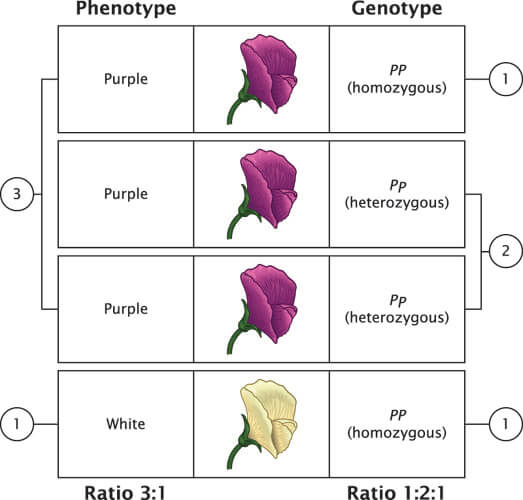
Homozygous:
- When both the genes are the same for a particular trait, for example- GG, YY.
- Where G is green and Y is yellow.
Heterozygous:-
- When both genes are different for a particular trait, for example- GY.
Phenotype:
- The sum of an organism’s observable characteristics is its phenotype.
- While genotype is inherited from an organism’s parents, the phenotype is not.
- Environmental factors that may influence the phenotype include nutrition, temperature, humidity, and stress.
- For example- Flamingos are naturally white in color, it is only the pigments in the organisms that they eat that cause them to turn vibrantly pink.
Genotype :
- It is the subsequent combination of genes that an individual possesses for a specific gene.
- For example- A gene encodes eye color.
- In this example, the allele is either brown, or blue, with one inherited from the mother, and the other inherited from the father.
- The brown gene is dominant (B), and the blue allele is recessive (b).
- If the child inherits two different genes (heterozygous) then they will have brown eyes.
- For the child to have blue eyes, they must be homozygous for the blue-eye gene.
-
UTILITY FOR BLOOD GROUP INHERITANCE (6:00 PM):
| Phenotype | Genotype |
| A | AA, AO |
| B | BB, BO |
| O | OO |
| AB | AB- Codominance where both the genes express themselves. |
- Both A and B are dominant over O.
- If both parents have the blood group A, the child can be O only if both the parents have AO AO, heterozygous groups.
- Such a correlation cannot be told for the Rhesus factor as per this concept.
|
Question 2: A married couple adopted a male child. A few years later, twin boys were born to them. The blood group of the couple is AB positive and O negative. The blood group of the three sons is A positive, B positive, and O positive. The blood group of the adopted son is:
(a) O Positive (b) A Positive (c) B Positive (d) Cannot be determined by the given data Answer- (a) As both A and B are dominant over O, their child cannot have an O blood group. |
Sex determination:
- Humans typically develop as either male or female, depending on the combination of sex chromosomes that they inherit from their parents.
- The human sex chromosomes, called X and Y, are structures in human cells made up of tightly bound deoxyribonucleic acid, DNA, and proteins.
-

- The phenotype ratio here is 1:1 as we see an equal number of sons and daughters.
- This means we have an equal probability of having a boy or a girl child.
- Humans who inherit two X chromosomes typically develop as females, while humans with one X and one Y chromosome typically develop as males.
- Hence, it can be said that the sex of the child is always determined by the genetic inheritance of the father, unlike the patriarchal norms that blame women for it.
GENETIC ABNORMALITIES (6:45 PM):
- Genetic disorders occur when a mutation affects the genes of the baby or when the baby has the wrong amount of genetic material.
Genetic disorders are classified on the basis of:
I. The number of chromosomes:
(a) Down Syndrome:
- It sees the presence of an extra chromosome called Trisomy 21.
- The child will have a total of 47 chromosomes.
- The child is born with a small round head, partially open mouth, and mental retrardation
-

(b) Klinefelter’s syndrome- XXY.
- The baby boy will have 47 chromosomes.
- This results in a male with the development of feminine characteristics.
- They are sterile in most cases.
(c) Turner’s syndrome- XO.
- It is a condition that affects only females when one of the X chromosomes (sex chromosomes) is missing.
- The girl will have only 45 chromosomes.
- She will be a reproductively sterile female.
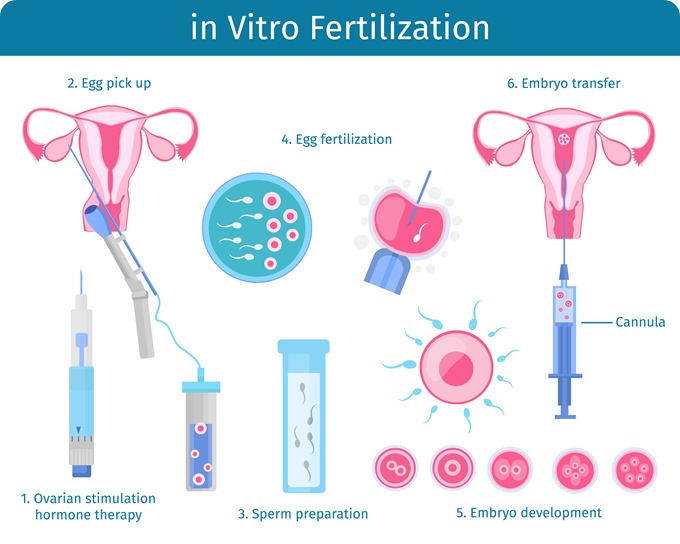
In-Vitro Fertilization :
- This process of embryo fertilization happens outside of the human body under monitored conditions.
- Mature eggs are retrieved from the ovaries and fertilized with sperm.
- After fertilization, the embryo(s) is/are transferred to the uterus of another woman.
- The birth then happens normally.
- The baby will have no characteristics of the host woman, but only of the parents whose sperm and eggs were taken.
-
TWINS (7:15 PM):
For identical (monozygotic) twins:
- The zygote can create a copy of itself.
- Hence the twins will have the same genetic material from both parents.
For non-identical twins:
- Normally, one egg cell is produced per month.
- Sometimes, two egg cells can be produced, or even both ovaries produce an egg cell each.
- Two zygotes will be fertilized and they will be genetically different.
- They would be similar to two siblings born with a gap of some time.
More examples of genetic defects/Autosomal diseases:
Sickle Cell Anaemia:
- Anemia refers to the deficiency of iron or hemoglobin.
- When the Red Blood Cells(RBCs) become sickle-shaped, they are not able to hold a sufficient amount of hemoglobin.
-

- This happens due to a defect in one gene present on one of the autosomes (one of the numbered chromosomes, as opposed to the sex chromosomes).
- Let the normal gene composition be HbHb and the diseased composition be Hb^sHb^s.
- We can have a heterozygous gene composition of the offspring as HbHb^s.
- In most cases, the defective gene effect is regressive, so the above-case offspring (HbHb^s) will be a normal person.
- This is because the normal gene Hb will dominate.
- So even if the defective gene is transferred in successive generations, they will not show the disease because the disease gene is recessive
Marriage among siblings/close relatives:
- They can be Carriers - they can be normal themselves, but they can still carry the disease to the next generation.
- HbHb^s & HbHb^s can have offspring -Hb^sHb^s which will definitely have the disease.
- Such marriages can cause offspring with physical, and mental genetic defects.
- This is also the reason why small tribes who do not marry outside the tribe are more likely to have genetic abnormalities.
SEX- CHROMOSOME-LINKED DISEASES (7:35 PM):
Hemophilia:
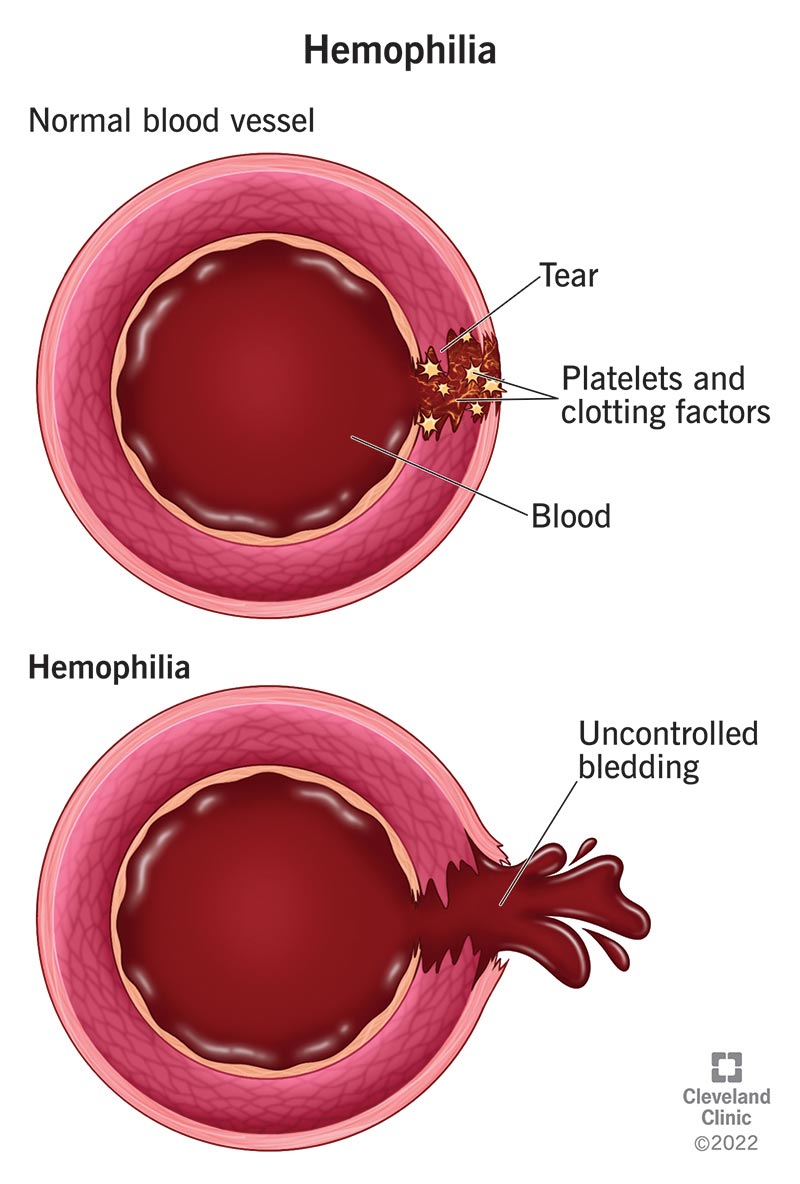
- Hemophilia is a rare disorder in which the blood doesn't clot in a typical way because it doesn't have enough blood-clotting proteins.
-
- The British Royal family has this disorder.
- This disease is also a recessive disease.
- Normal- XX & XY.
- Let us assume the diseased female to be represented by X^hX^h.
- Let us assume the parents as XY & X^hX^h.
- Since this is a recessive disease, the offspring will be either :
- I. XX^h (Normal/Carrier female child).
- II. X^hY( Diseased male child)
- For sex-linked diseases, either the man will be normal or he can be diseased, but he will never be a carrier.
Color Blindness:
- The gene responsible for color blindness is located on the X chromosome.
- If a female inherits one normal color vision gene and one mutated gene, she won’t be red-green color blind, because it’s a recessive trait.
- But if she inherits two mutated color vision genes, she’ll be color-red-green blind.
- Since boys have only one X chromosome, their chance of inheriting red-green color blindness is much greater.
- Boys always inherit their X chromosome from their mother, so if the mom has red-green color blindness, or if the mom’s dad is red-green colorblind, her son will be too.
- Normal- XX, XY
- Disease X^hX^h, X^hY
- Normal carrier XX^h.
-
Question: In the context of genetic disorders, consider the following(Prelims 2009):
- A woman suffers from color blindness while her husband does not suffer from it.
- They have a son and a daughter.
- In this context, which one of the following statements is most probably correct:
- (a). Both children suffer from color blindness.
- (b). The daughter suffers from color blindness, while the son does not.
- (c) Both children suffer from color blindness.
- (d). The Son suffers from color blindness while the daughter does not.
- Answer: (d)
- Approach:
- Let the mother be X^cX^c (diseased) and the father be XY (healthy).
- The offspring will be:
- XX^c(daughter) , XX^c(daughter), X^cY,(son) X^cY(son).
Ncerts for self-study:
- Class 10- Chapter 8
- Class 12- Chapters 4 & 5 (only basics).
THE TOPICS FOR THE NEXT CLASS ARE Biotechnology.